Your money can help your family today.
As an estate planning attorney, I often see a striking difference between parents' assets and their children's financial lives. Parents may have substantial savings. Their adult children are trying to buy a home, raise a family and manage housing costs on a much tighter budget.
Rising living costs since 2020 have made that challenge harder. Higher costs for groceries, rent, utilities and insurance can leave less of each paycheck for a down payment, closing costs and emergency savings. Even when inflation slows, families still face the higher price levels built up over the past several years. A young adult may be earning more than before and still have little room left to buy a home. That is why a lower, sustainable mortgage payment can matter so much.
A layoff, reduced hours or an economic slowdown can make that gap painful. In October 2026, the unemployment rate for people ages 20 to 24 was 7.5%, compared with 4.1% overall. A young adult does not need to experience a national recession to feel the strain of losing a paycheck.
Years ago, a Muslim father came to see me because he wanted to help his daughter buy a home while honoring his religious beliefs about interest. That conversation stayed with me. A family's values, its financial needs and its estate plan should be considered together. Religious compliance requires its own qualified guidance; changing the name of an interest charge does not settle that question.
For some families, part of the answer is a family mortgage. Your child buys and owns the home. You provide the financing. Your capital helps someone you love, and the agreed payments come back to you.
The child owns the home. The parents hold the loan.
At a purchase closing, the deed places ownership in the child's name. The child signs a promissory note, and a properly prepared and recorded deed of trust secures repayment. The parents, or an appropriate lending entity, hold the loan. A lender's title insurance policy can be considered to protect the insured lien, subject to its terms.
This structure gives the child the responsibilities of ownership and the opportunity to build equity. An eligible child who owns and occupies the property as a principal residence may qualify for Texas residence homestead tax exemptions. Those exemptions have their own requirements; family financing does not automatically qualify or disqualify the owner.
If an LLC is appropriate, it belongs on the lending side of this plan. Moving the child's home into an ordinary LLC can change the homestead analysis. Keeping the loan and the ownership clearly documented matters.
Already own a home? A family refinance may create breathing room.
The same conversation can help a child who already has a mortgage. Parents may be able to fund a properly arranged refinance that pays off the existing lender and replaces that debt with a family loan secured by the home. The child keeps ownership, while the family agrees on a sustainable rate and repayment schedule.
That can be especially useful after a job loss. A lower payment may help a child get back on their feet. Parents may also agree to temporary relief, with a written plan stating when payments resume and how missed amounts will be handled. The parents must be able to afford the interruption themselves. A genuine loan still needs a realistic repayment plan and compliance with any applicable lending requirements.
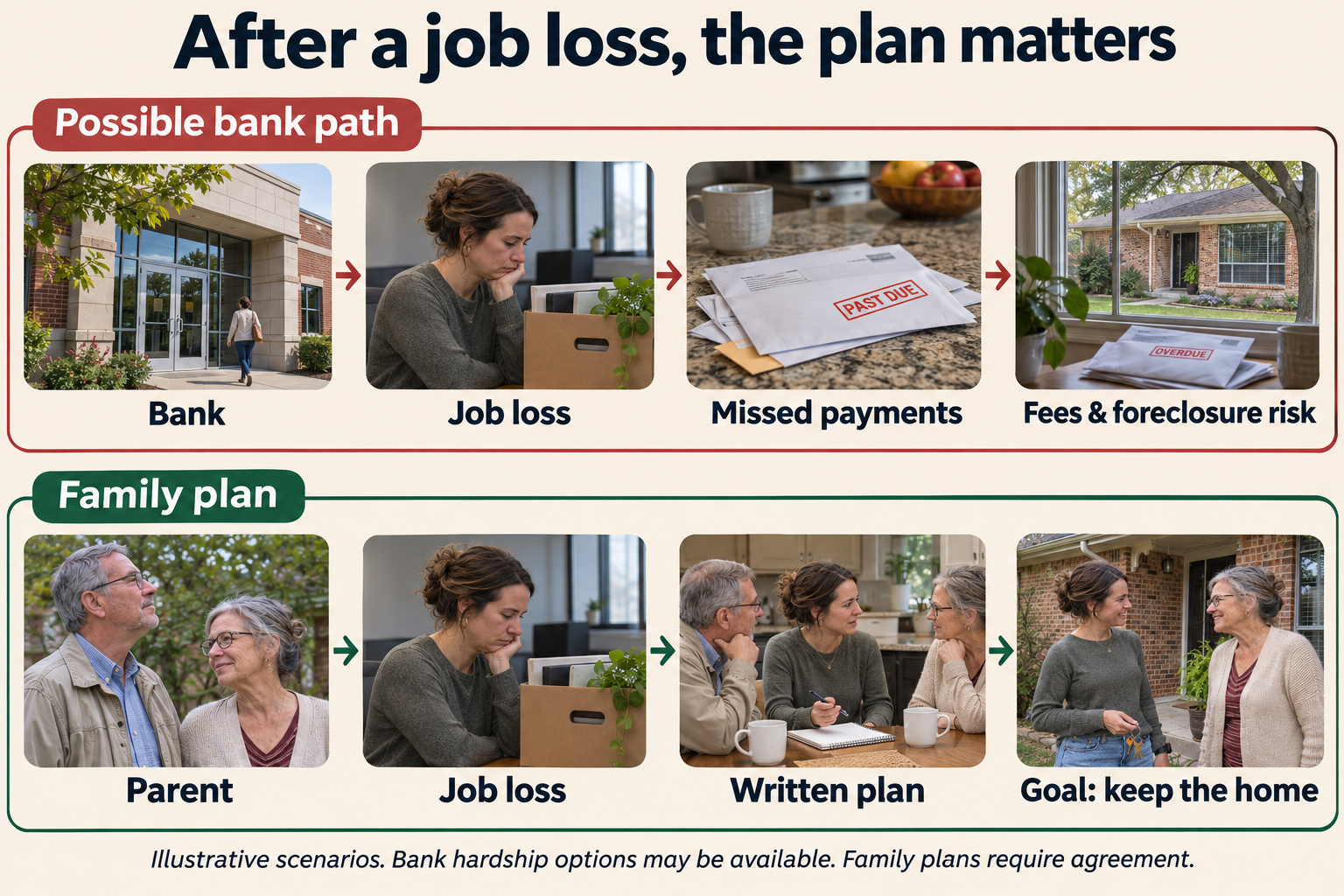
Parent: job loss → written plan → goal: keep the home.
Illustrative scenarios. Bank hardship options may be available. Family plans require agreement and the means to follow through. Open the larger diagram.
Arrange the refinance before paying off the old lender. Texas limits the liens that can attach to a homestead, and a valid new lien and its priority require careful closing work. Existing home-equity debt, cash taken out and the proposed lender's qualifications can change the rules. A family-owned LLC does not automatically receive an individual's family-member exemptions.
A longer term can reduce the monthly payment while increasing total interest. Compare both the monthly relief and the cost over the full term. Also ask the existing servicer about available hardship options before choosing a replacement loan.
A retirement cash-flow goal can become a housing solution.
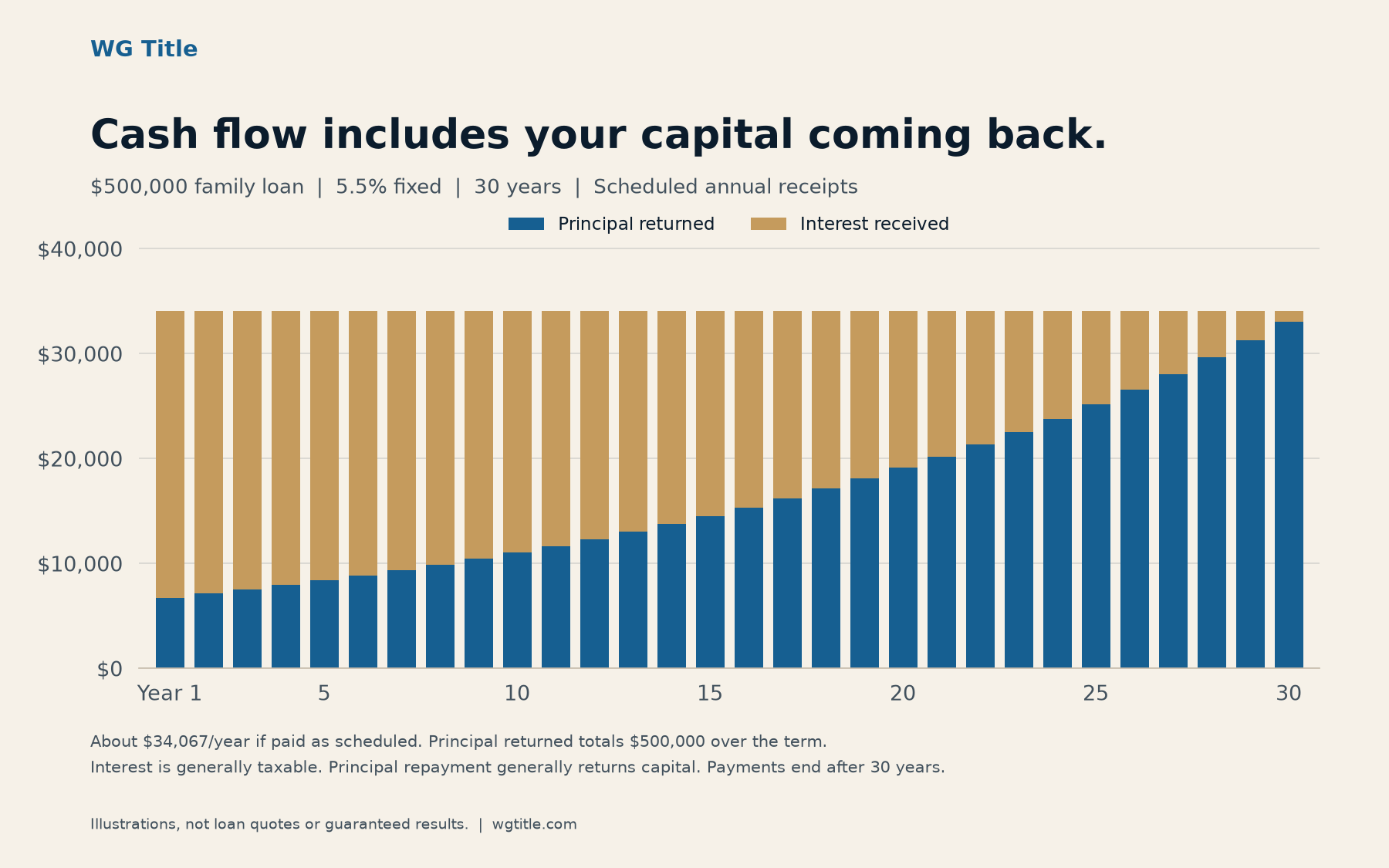
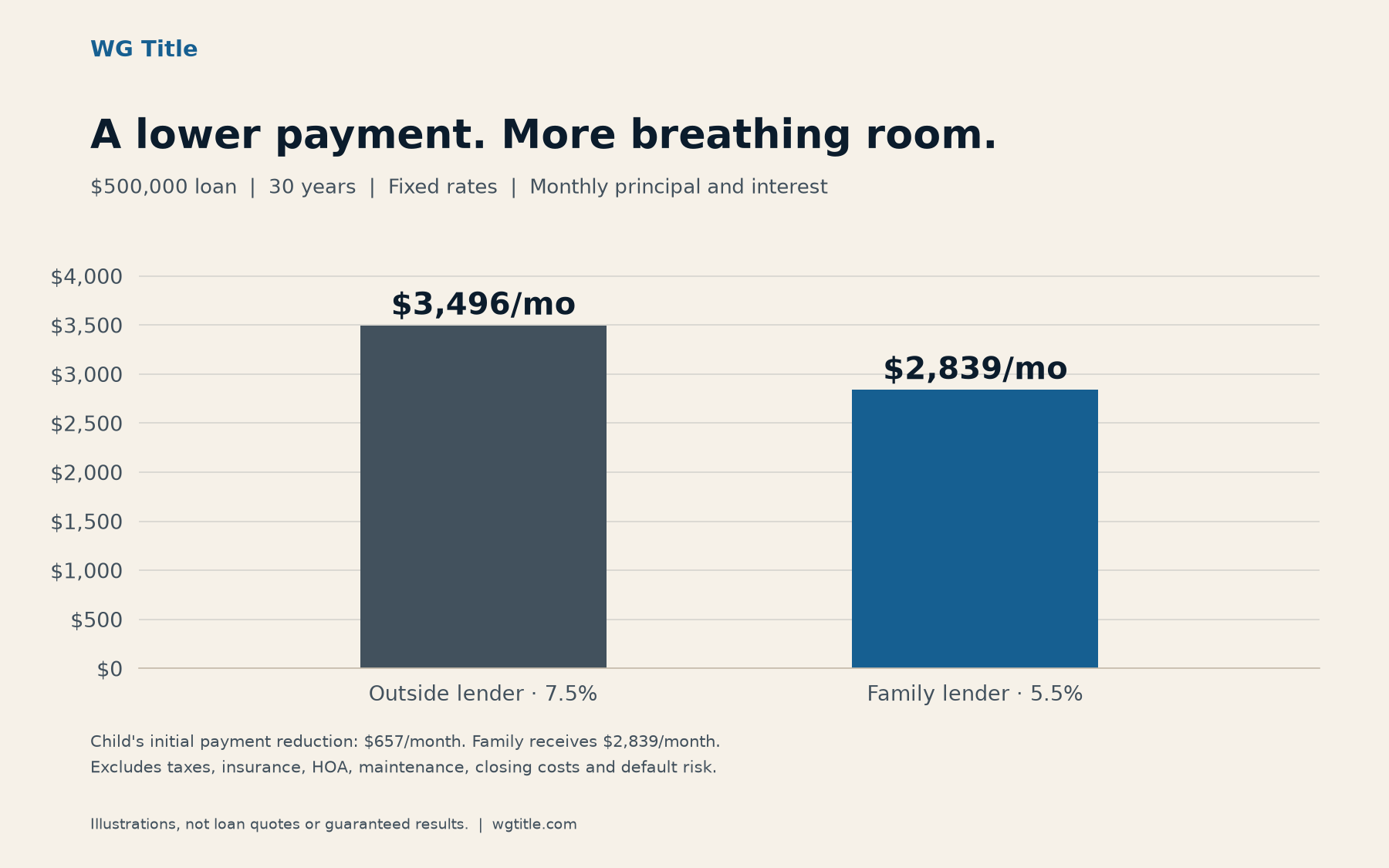
Imagine you are 65 and would like roughly $2,500 a month in additional cash flow. At an illustrative fixed rate of 5.5% over 30 years, a $440,000 family loan produces principal-and-interest payments of about $2,498 a month. A $500,000 loan at the same rate and term produces about $2,839 a month.
For a $500,000 balance over 30 years, reducing an illustrative outside rate of 7.5% to a family rate of 5.5% lowers principal and interest by about $657 a month. These are examples, not current loan quotes or a statement that a particular rate is legally or financially appropriate.
The parents commit the money upfront. These scheduled payments are finite, include repayment of that capital, and depend on the child paying. Taxes, insurance, maintenance, association charges and closing costs are additional. Inflation can reduce the purchasing power of a fixed payment.
Invest in the Family Future.
One client had $2 million invested in bonds earning less than 4%, while his two adult children were still renting apartments. In 2018, he put some of that money to work financing a home for each of them. His children bought and owned their homes; he became their lender.
In 2021, both children refinanced at lower interest rates and repaid their father. They kept their homes, which have since appreciated significantly in value. His money helped his children move from paying rent to building equity, and then came back to him. To me, that is great estate planning.


AI-generated illustrative photos; these are not the clients or homes in the story.
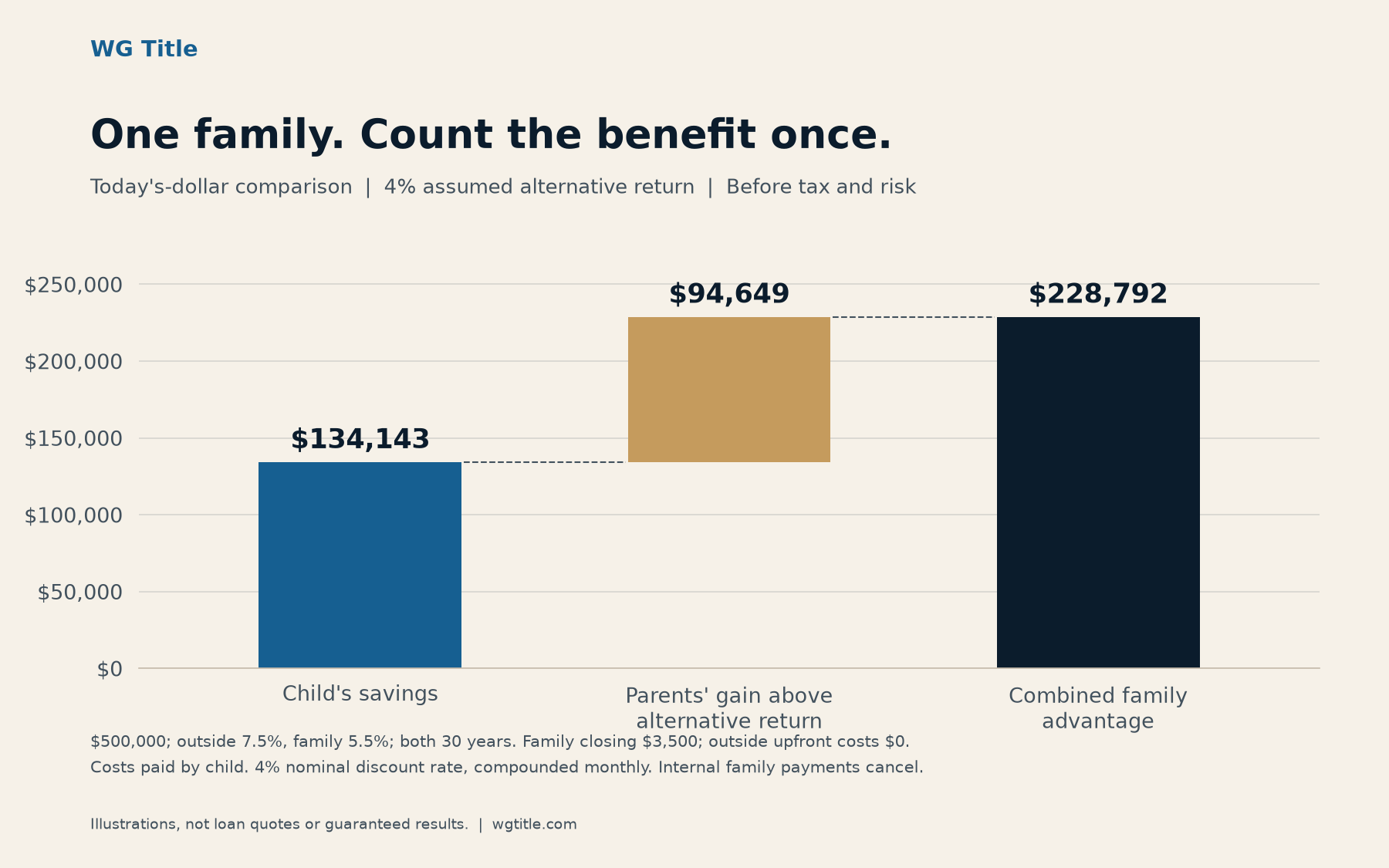
With a conventional mortgage, the interest goes to an outside lender. With a family mortgage, the interest stays between the child and the parents. Parents can choose not to charge their own origination fee.
The family interest rate changes how the benefit is divided. A higher rate is not always better for the parents: it raises the child's payment and generally creates more taxable interest income for the parents. WG Plan can help you compare the after-tax results and choose a rate and repayment plan that work for the whole family.
Build in flexibility, security and a plan for inheritance and long-term care.
Another client had saved $3 million and was comfortably living on the interest from bonds. In 2024, a car accident involving a moose while he was traveling in Canada left him in the hospital for a month. He was shocked to learn that Medicare would not cover his care there. A $2.1 million hospital bill changed his retirement forever. He had not put asset protection in place for his brokerage account.

His experience shows why planning should happen before a crisis. Medicare generally does not cover care outside the United States, with limited exceptions; supplemental or private coverage may differ. A properly structured LLC holding family mortgage loans may offer protection from a member's personal creditors under Texas charging-order law. Whether that structure would protect assets in a particular case depends on the claim, the ownership and the timing of the planning.
Families can document patience after a setback and decide how an unpaid balance should affect the child's inheritance. They can also plan for the surviving parent, incapacity, sale, divorce and death. The parent's death does not automatically pay off or cancel the note. Any forgiveness or inheritance adjustment must be coordinated in the estate plan, with lien-release and tax consequences addressed.
The loan still needs sound protections of its own: proper documents, suitable insurance, paid property taxes and enough equity to support repayment. Foreclosure, when legally available, does not guarantee recovery. An LLC does not make the home, the note or distributions lawsuit-proof, and moving assets after a claim arises can create fraudulent-transfer issues.
Credit-bureau reporting and tax reporting are different subjects. Family payments do not automatically build a child's credit history, and a private arrangement does not eliminate applicable reporting or servicing obligations.
Long-term care is another reason to plan early. Texas Medicaid may exclude qualifying business assets while counting the income they produce. For a family that meets the rules, nursing-home Medicaid eligibility may be possible while preserving assets that qualify for an exclusion. Simply putting mortgage notes in an LLC does not establish that exclusion: the notes, your LLC interest and the business activity must be evaluated, and promissory notes can be countable resources.
Talk with an elder law attorney before using this idea for Medicaid planning. The attorney can review the business-property rules, how loan payments and distributions will be treated, the five-year transfer look-back and any income that must go toward care. Creditor protection and Medicaid eligibility are separate questions; both deserve a plan tailored to your family.
Put the plan together before the money moves.
As an estate planning attorney, I cannot recommend this approach for every family. But for the right family, it can be a very good idea: an investment that supports both parents and children, with opportunities for asset protection and long-term-care planning, all within the family. The plan has to support the parents' retirement as well as the child's budget.
Financial advice should consider the whole family, including ideas that move money out of a managed investment account. When an adviser's fees are tied to assets under management, that move may reduce the adviser's compensation. It is an incentive families should understand when weighing a family mortgage.
Our sister company, WG Plan, can help you understand the risks and benefits, compare the alternatives and decide what fits your family. I know the purpose behind that work because I am one of WG Plan's founders, and I hold a Master of Science in Personal Financial Planning. Our goal is to help clients choose what serves them best, even when that means fewer assets under management.
WG Law can advise on the structure and draft the documents. WG Title can coordinate title review, escrow and the closing. Each company is independently operated, with its own professionals, agreements and responsibilities. Legal services require a separate accepted engagement and conflict review; you can use your own advisers.
Your savings can support your retirement and help your children or grandchildren establish a home. Start with the numbers, agree on the expectations, and give the plan the same care you would give any substantial investment.